
on the cognitive triviality of art.
In “On the Cognitive Triviality of Art'' by Jerome Stolnitz, he provides a claim with substantial evidence that art does not contain real truth. His claim is rooted in specific relation to literature pushing ideas out, in which one might see as trivial. He starts off his text by recalling the ideas of Plato and explaining how the cognitivist ideas of artistic truths can belittle parts of Plato's literalism. Stolnitz uses the term "fairly inconsequential" to explain exactly how art's influence on social structures, with historical change, backs up his argument on cognitive triviality. He also brings up truths that he described as “beyond dispute” referring to scientific truths, to help define his idea of artistic truths.
Scientific truths viewed in this specific way show truths of the ‘great world’ in which Stolnitz begs the question of whether artistic truths do the same. This is the point within the text in which Stolnitz brings up the idea of banal truths, which are truths that are extremely familiar and easy to understand, as they are not subjective. Artistic truths, on the other hand, are too suggestive in the way Stolnitz describes them, to be on the verge of these scientific truths.
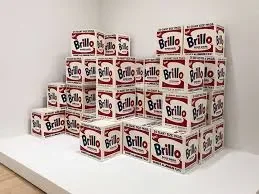
Brillo Boxes, Andy Warhol 1970
Retouching on the idea of literature that Stolnitz begs to be his main point, the idea is that art is not the truth itself, but literature (art) is what can bring the truth to light. To back up this point, he brings up that to see the points of the literary pieces, we have to abandon crucial details that pull the truth separate ways from the artistic piece. In more simple terms, the literature that is written is simply adding on to the truth already there as if it is not needed to see the truth in a clearer light. To describe the truth or point of literary pieces, we must break them down to a very simplistic meaning, which seems to defeat the point of literature. Furthermore, Stolnitz believes that literary pieces flesh out their "truth" in very intricate ways, but will always circle back around with one simplistic, banal, meaning. By explaining, this is the evidence he uses in order to back up his claim that literary pieces have no truth to them, as outside connections have to be made to see a banal truth.
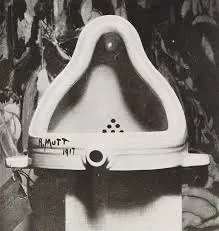
Marcel Duchamp, Fountain, 1917, Photographed by Alfred Stieglitz.
As Stolnitz builds up this simplistic, and argumentative view of what exactly brings artistic value, he specifically narrows the focus on the artistic truths as he makes it a point to find these specific truths within literature. By doing so, he neglects to think of artistic truths as cognitive truths in the plain form. Instead of looking at art from the perspective of simply delivering a truth, we should consider the idea of art's ability to help generate these cognitive ideas and ways of thinking. Art should not be reduced simply down to the truth, because the truth may be a small portion of the larger ideal trying to be portrayed within a piece. Searching for the simple, artistic truth may leave out key details to contribute to one's viewpoint of these certain ideas.
By simply looking for the truth within a piece, we neglect the enrichment and connection that we can have with art.
I also recommend reading this piece HERE by Benedetta Ricci. It is over the aesthetic of the banal within contemporary art.
short and sweet today, enjoy!